sales@vg-med.com
 Язык




Что Вы ищете
?
An operating table on its own does exactly one thing well: it holds a patient flat, on their back. Everything else a surgical team needs — lithotomy, lateral decubitus, beach chair, traction, skull fixation — depends on what you bolt onto it.
That is why accessory specification deserves more attention than it usually gets. A hospital that buys a capable table but a thin accessory set ends up with a table that only handles general surgery. A distributor that stocks the wrong rail standard ends up with returns.
This guide covers what operating table accessories are, how the three international rail standards differ, what each accessory category does, and how to specify a set that will still be serviceable ten years from now.
Operating table accessories are functional attachments that mount onto a surgical table's side rails, tabletop sections, or accessory sockets to position, support, or restrain the patient, or to hold equipment used during the procedure. They extend the range of positions and procedures a table can support without replacing the table itself.
The category splits into three functional groups:
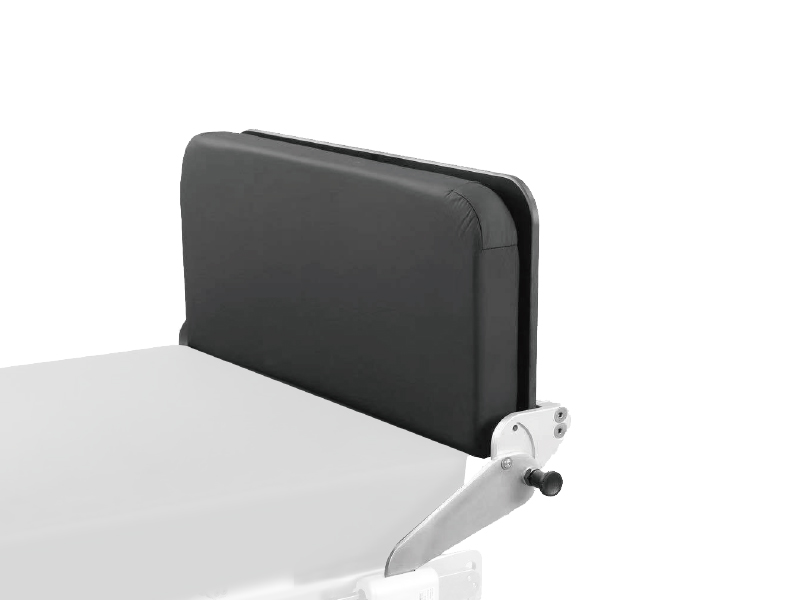
· Positioning and support — armboards, leg supports, stirrups, head rests, shoulder and body supports, hip supports.
· Interface and fixation — rail clamps, socket fasteners, extension rails, restraint straps.
· General utility — anesthesia screen frames, IV poles, drain pans, instrument and KUB boards.
One boundary is worth stating plainly, because it causes real procurement errors.
A table's clinical range is not set by its motors. It is set by what attaches to it.
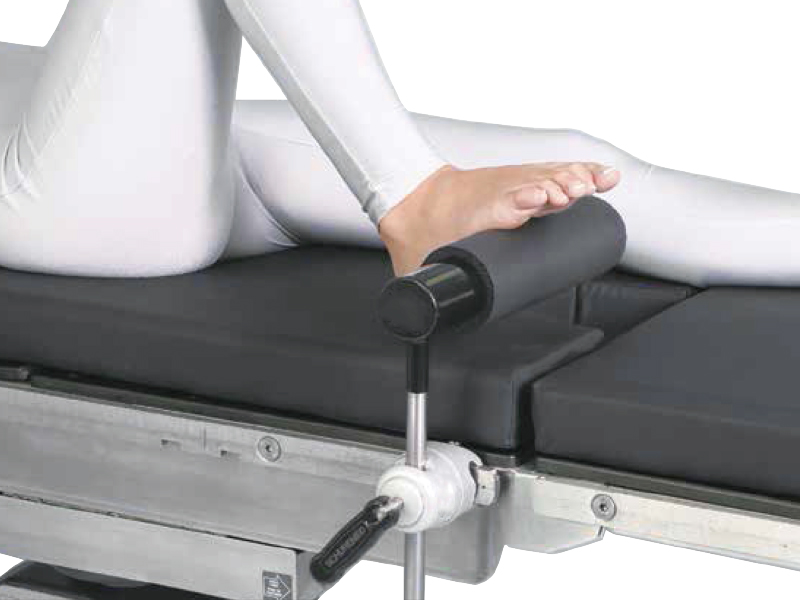
Take lithotomy. The table needs to tilt, but the position itself is created by leg supports or stirrups plus hip stabilisation. Without those two components, no amount of electro-hydraulic articulation produces a usable lithotomy position.
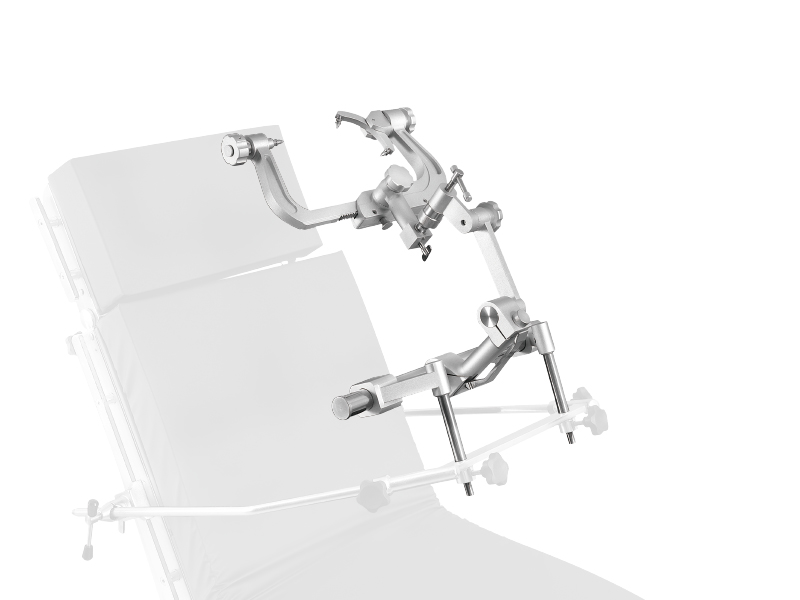
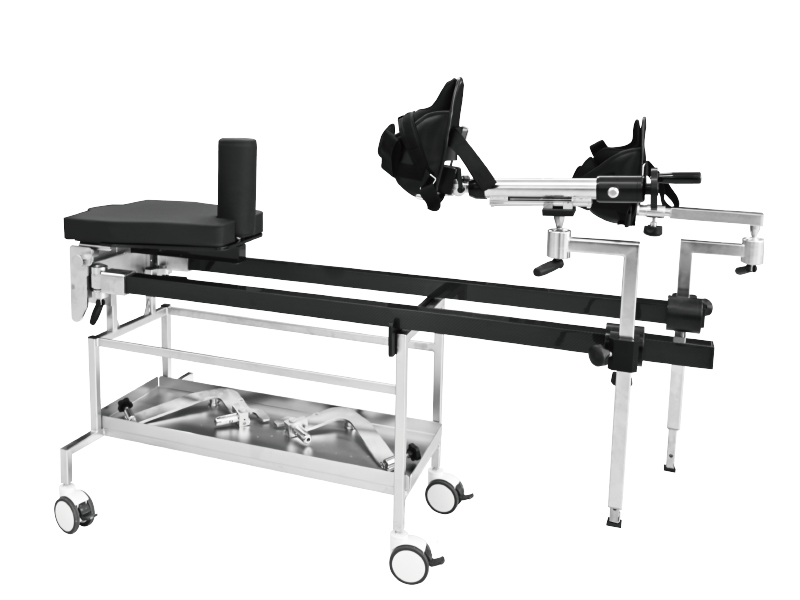
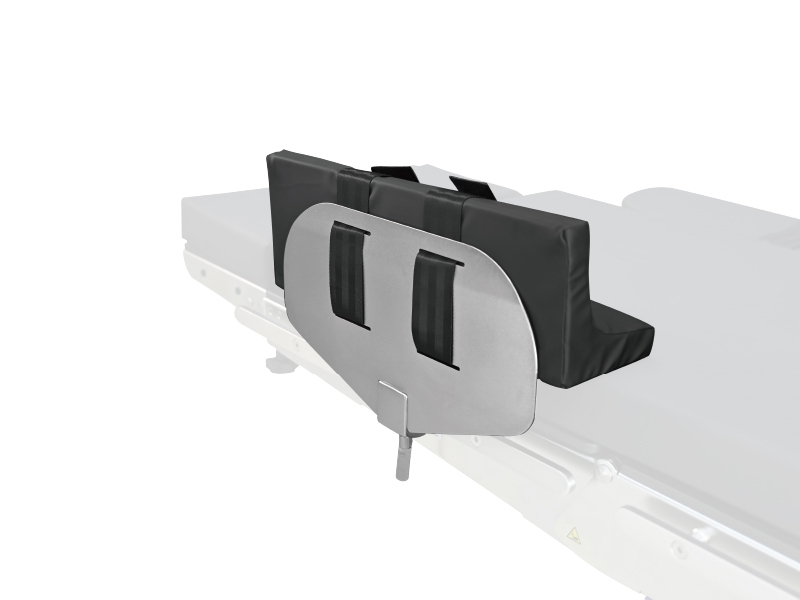
The same logic applies across specialties. Lateral decubitus needs a lateral support, an axillary roll, and a head rest that clears the dependent shoulder. Beach chair needs shoulder supports and a head frame that holds neutral alignment. Neurosurgery needs a skull clamp or a horseshoe head rest depending on the approach. Orthopaedic traction needs a traction frame and a perineal post.
This is why accessory budget belongs inside total cost of ownership rather than in a separate consumables line. A table bought without its accessory set is a table that will be worked around — with borrowed equipment, improvised padding, and positions the team would rather not hold for four hours.
If table and accessories are being specified together, our guide to how to choose a surgical table covers the platform decisions that constrain the accessory set.
Nearly every accessory in the world attaches through one of three side rail profiles. Get this wrong and nothing else in the specification matters.
The 25 × 10 mm rail is the European and wider international default, and the profile most Chinese-manufactured tables are built to. It is a rectangular rail, 25 mm tall by 10 mm deep, running the length of the table's side.
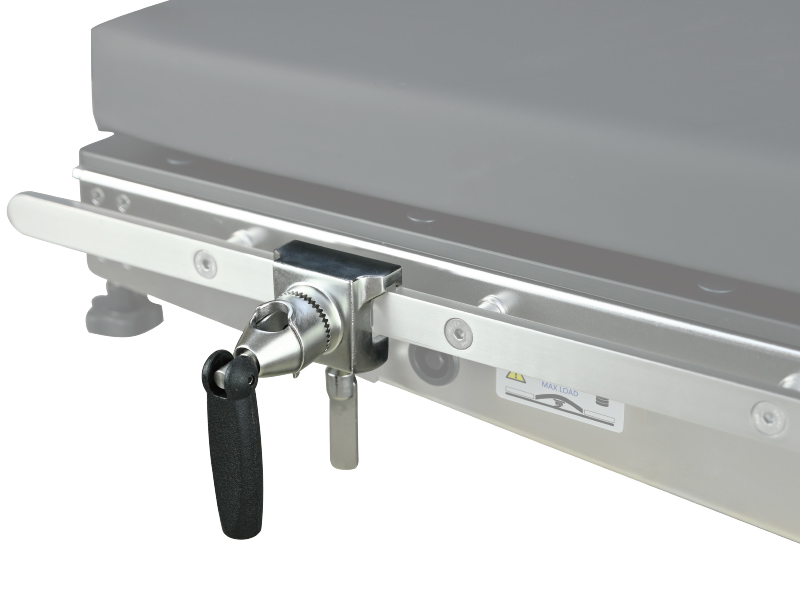
This is the profile VG Medical accessories are designed around. Our side rail socket clamps mount directly onto it and accept round rods up to Φ16 mm or rectangular accessory bars up to 6 × 25 mm.
The North American standard measures 1-1/8 inch by 3/8 inch — approximately 28.5 mm by 9.5 mm. Superficially similar to the European rail, and completely incompatible with it. A 25 × 10 mm clamp will not seat securely on a US rail, and the reverse is equally true.
If you are supplying North America, this is the first question to settle, before models, before colours, before price.
The UK profile runs 1-1/4 inch by 1/4 inch, roughly 31.75 mm by 6.35 mm. Narrower and shallower than either of the other two. It appears on older UK-built tables and on equipment supplied to Commonwealth markets.
Adapters exist for every combination, and they work. What they also do is add a joint. Every additional joint is a place where clearance can develop, where a clamp can be tightened against the wrong surface, and where cleaning is harder because two components now overlap.
For a single table in a single hospital, an adapter is a reasonable answer. For a fleet, or for a distributor building stock, standardise on one rail profile per market and buy accessories to match. The cost of doing this at the specification stage is close to zero. The cost of discovering it after delivery is a container of unusable steel.
The table below maps the main categories of operating table accessories to their clinical purpose.
|
Category |
Typical components |
Primary purpose |
|
Arm support |
Armboards, arm surgery boards, surgeon arm rests |
Arm positioning, IV access, hand and shoulder procedures |
|
Leg support |
Leg supports, stirrups, suspended slings |
Lithotomy, gynecology, urology, perineal access |
|
Head support |
Head rests, horseshoe rests, adapter frames |
Head stabilisation, airway access |
|
Trunk support |
Shoulder supports, body supports, lateral supports |
Lateral and beach chair positioning |
|
Hip support |
Cylindrical hip supports, perineal posts |
Lithotomy counter-support |
|
Interface |
Rail clamps, socket fasteners |
Connecting everything above to the table |
|
Utility |
Anesthesia screens, IV poles, straps, drain pans |
Airway barrier, access, fixation, fluid management |
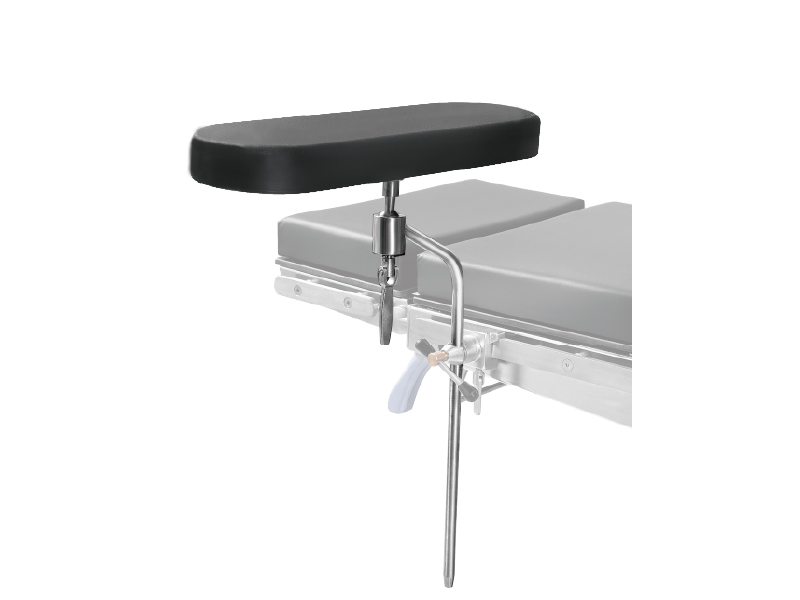
Armboards are the most frequently used accessory in any OR. A basic armboard consists of a support rod, a board, and a pad, with independent height and rotation adjustment and two straps for fixation. Pad thickness matters more than board size for pressure comfort; 60 mm is a common specification.
For procedures requiring intraoperative imaging, radiolucent boards matter. Our arm surgery boards come in two versions — bakelite (#1508.0000) and carbon fibre (#1601.0270) — both 800 × 350 mm, both X-ray transparent. The carbon fibre version costs more and weighs less; the bakelite version is the pragmatic choice where imaging is occasional.
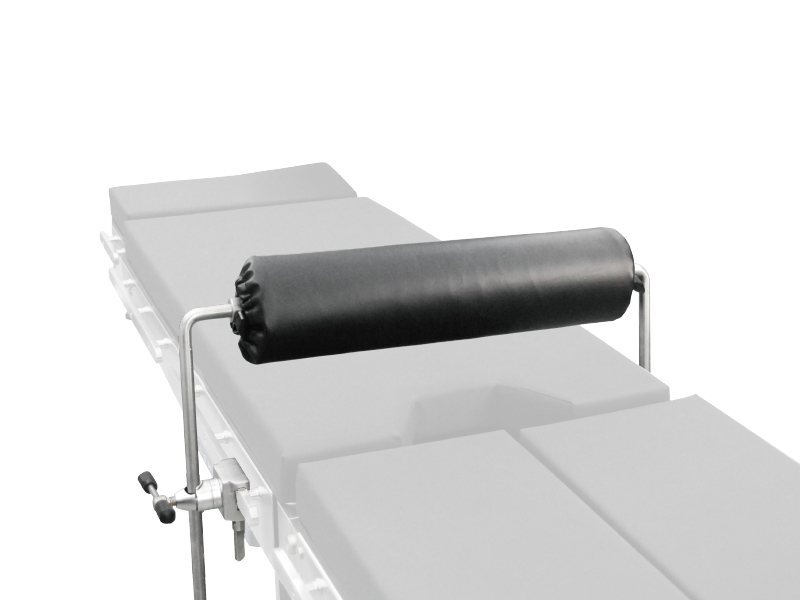
Leg supports range from a simple rod-and-cushion design (#1505.0010) through suspended slings for patients who cannot tolerate pressure on the calf, to gas-spring stirrups (#TA0020) where a single-handed adjustment during draping saves real time. For lithotomy, leg support alone is not enough — a cylindrical hip support provides the counter-pressure that stops the patient sliding when the table is tilted.
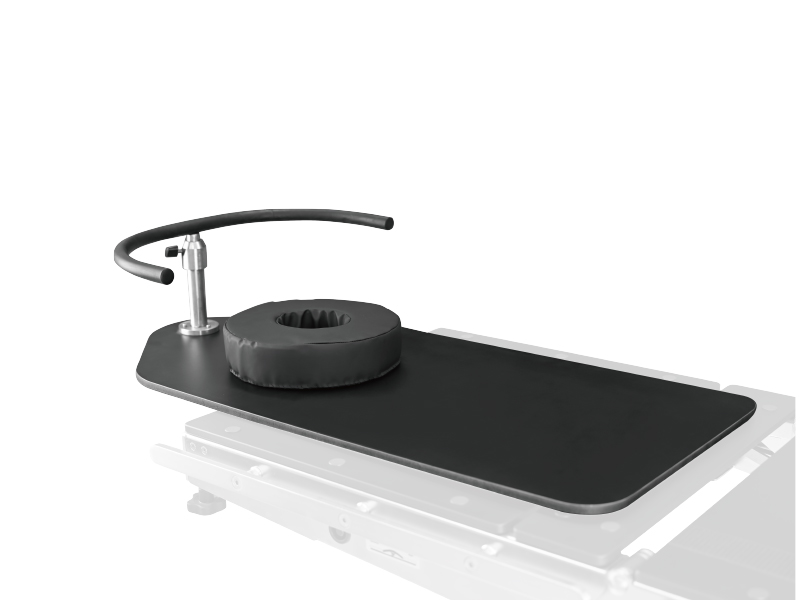
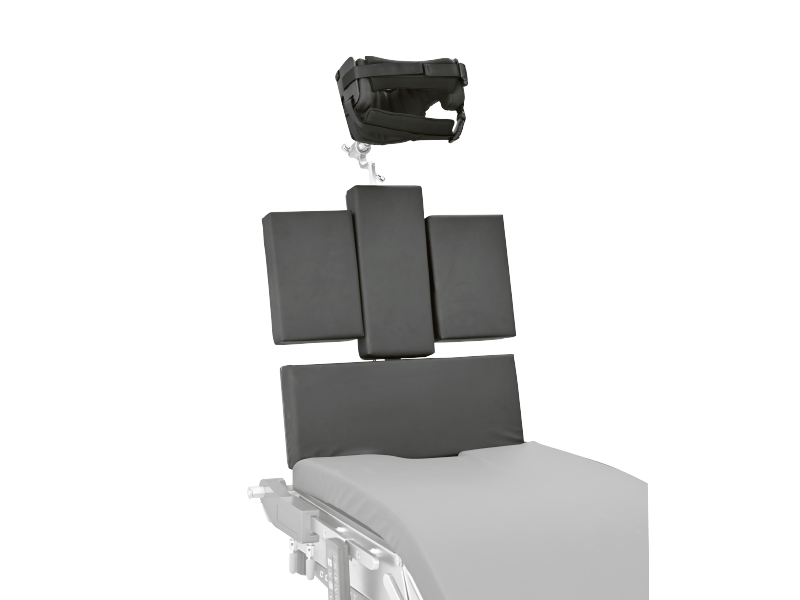
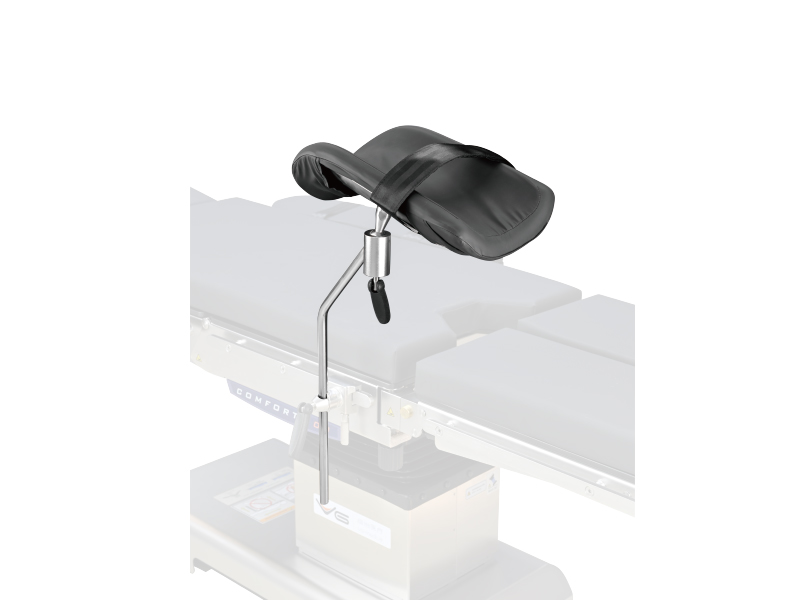
Head rests come in two architectures. A conventional head rest (#1514.0000) mounts through an adapter frame (#1413.0100 for COMFORT 300, #1413.1200 for Vcare 2111) that converts the table's head section into a standard accessory interface. A horseshoe rest (#5732.0120) mounts directly on the head section and leaves the face open for prone and neurosurgical access.
Clamps are where accessory systems succeed or fail. They are also where most suppliers compete on price and lose on function.
The functional differences are specific:
· Rotational vs non-rotational. An adjustable socket clamp (#1401.0000) allows 360° rotation, which is what you want for armboards. A square clamp (#1402.2000) locks rotation, which is what you want for anything that must not drift under load.
· Self-locking. A clamp that self-locks (#5737.0018) prevents an accessory dropping if the handle is knocked during a case. This sounds like a small feature until it happens.
· Sterilisability. Clamps used in septic or aseptic fields need high-pressure steam sterilisation. Our multifunctional fastener (#5737.0019) is built from aluminium-magnesium alloy specifically so it can be autoclaved without the weight penalty of stainless.
· Bore capacity. Most designs accept Φ16 mm rods; quick-release types (#5737.0020) accept Φ20 mm. If your existing accessories use thicker posts, this is the number to check first.
All VG clamps are SU304 stainless except the Al-Mg variants, and all are rated for high-temperature and high-pressure sterilisation. Corrosion resistance and cleanability are design requirements, not marketing claims — the rail interface is a crevice that collects blood and saline, and it is the first place a cheap clamp fails.
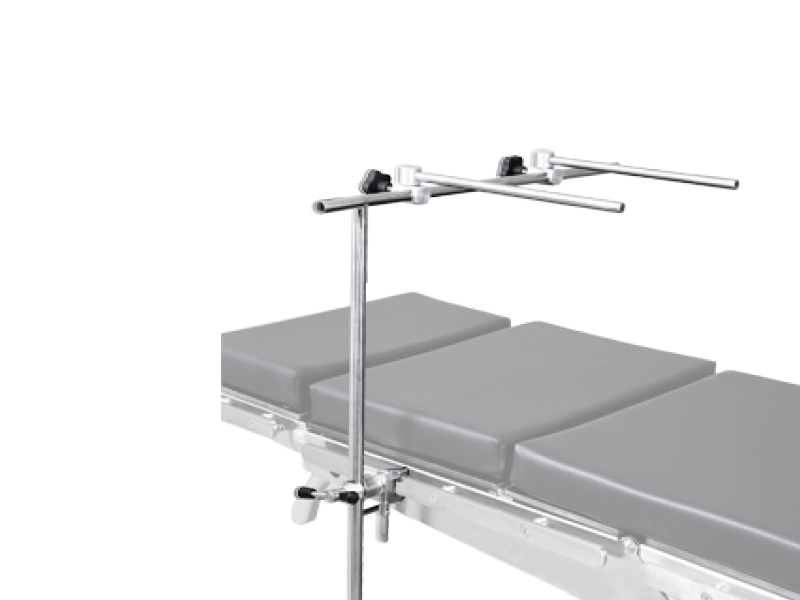
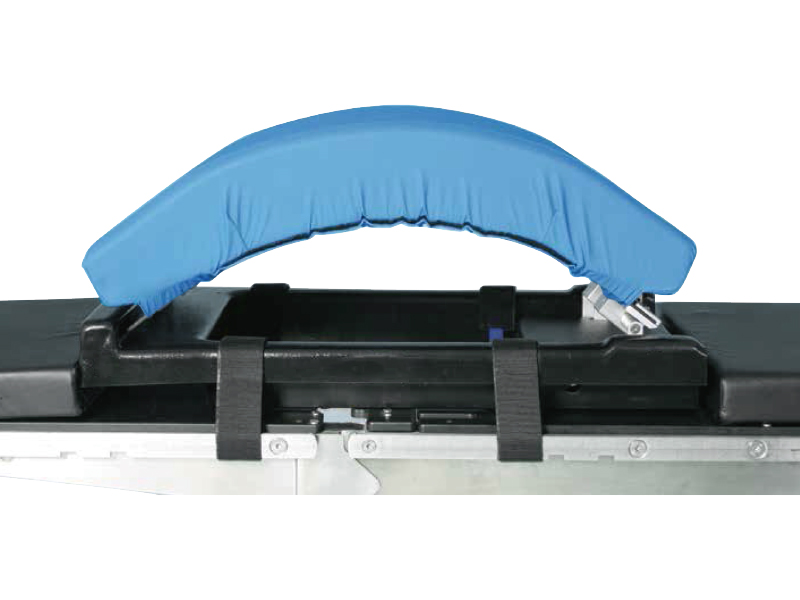
Anesthasia screen supports hold the drape barrier that separates the airway from the surgical field. Height adjustability is the variable that matters: a fixed frame (#1601.0140) works for a standard table height, an adjustable one (#5737.0005) works when the table is dropped for sitting positions, and a curtain support frame (#1404.0000) forms a full support surface through mounting arms for longer cases.
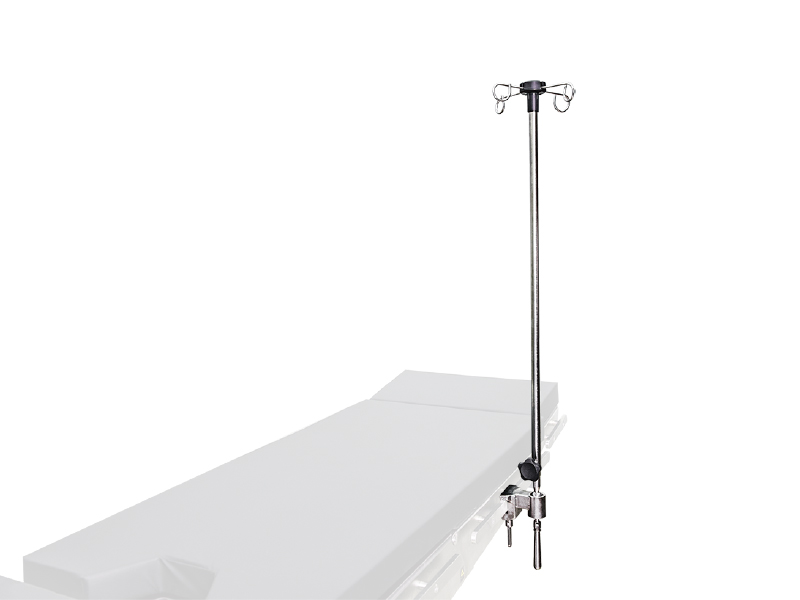
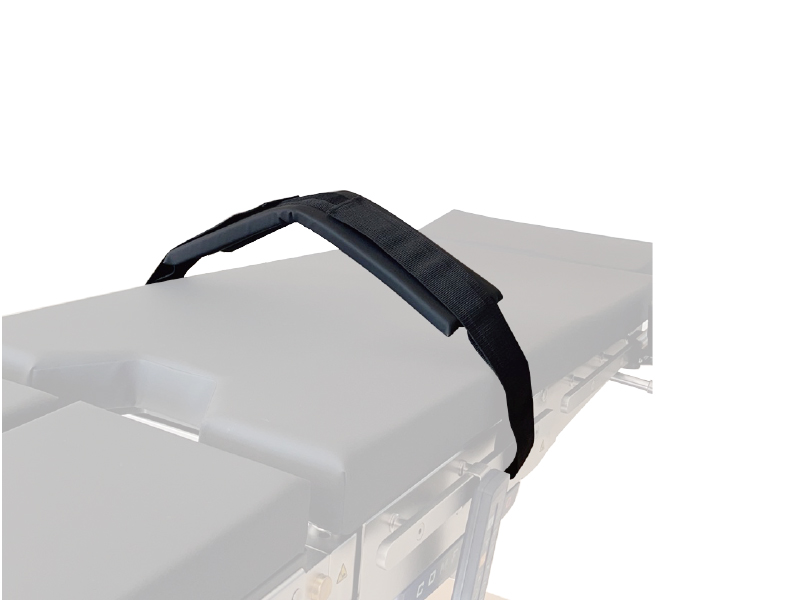
IV poles, restraint straps, and drain pans round out the set. None of them are technically demanding. All of them are the items that stop a case when they are missing.
A well-specified accessory set is built backwards from case mix, not forwards from a catalogue.
Two armboards, an anesthesia screen, an IV pole, and a pair of leg supports cover the majority of volume. Add a cylindrical hip support if the table tilts routinely.
Traction frames, perineal posts, radiolucent armboards, and a range of clamps for limb positioning. Orthopaedic cases also load the table asymmetrically — a limb held in traction puts force through a single side rail rather than the tabletop. This is the specialty where clamp quality shows up first.
Leg supports or stirrups, hip supports, and a drain pan. Stirrup choice drives workflow: fixed rod supports are cheap and slow to adjust; gas-spring stirrups cost more and save minutes per case, which matters in a high-volume cystoscopy list.
Skull clamps or horseshoe head rests, plus a table that can be rotated and tilted without losing rigidity. Prone positioning adds chest and pelvic bolsters to the accessory list, and those bolsters must not compress the abdomen.
Lateral and Beach Chair Positioning
Lateral position needs a lateral support, an axillary roll, and arm support on the dependent side. Beach chair needs shoulder supports, a head frame, and — critically — a table that can achieve the required back section angle without the accessory set shifting. Shoulder arthroscopy is the case where a poorly chosen shoulder support becomes a patient safety issue rather than an inconvenience.
Our surgical table positioning guide covers the clinical sequence for each of these positions in more detail
Accessories inherit their safety obligations from the table they attach to. There is no separate IEC particular standard for armboards or clamps — the requirements come from IEC 60601-2-46, the particular standard for operating tables, and from risk management under ISO 14971.
The current edition of IEC 60601-2-46 requires that a table withstand 2.2 times its safe working load in normal position at maximum height, held for five minutes, with no permanent deformation — and that deflection after load removal return within ±2.5 mm of the original reading. The table must then operate through its full range of movement.
Tensile safety factors are set by material and by whether the component is subject to wear: 2.5 for a non-wearing support system in ductile material, rising to 8 for a wearing system in a material with less than 5% elongation. Clamps, by definition, wear. They cycle against a rail hundreds of times a year.
The standard addresses accessories directly at one point: when deformation is measured, the measuring point for accessories is determined according to their intended use. In practice this means the accessory is tested as part of the system, in the position it will actually be used.
Two further provisions shape accessory selection. First, mass distribution assumptions for patients above 135 kg allocate roughly 32% to the lower limbs (16% per leg), 32% to the lower trunk, 14% to the upper trunk, and 2% to the head. A leg support carrying 16% of a 200 kg patient is holding 32 kg, and it is holding it at a lever arm. Second, tables used within 2 m of high-frequency surgical equipment must pass specific electromagnetic immunity tests with no unintended movement — which is a system property that an accessory can degrade if it introduces a conductive path.
Ask for the load rating of every load-bearing accessory, not just the table. A table rated for 350 kg with leg supports rated for 15 kg each is a specification with a hole in it.
Four material families cover almost every accessory on the market, and each is a trade-off rather than an upgrade. Matching the material to the function the component performs is the whole game.
304 stainless is the default for load-bearing accessory components, and it earns the position. It resists corrosion from saline and cleaning agents, tolerates repeated autoclaving, and holds tolerance under clamping force. Support rods, clamp bodies, and leg support frames in a serious accessory range are stainless for good reasons.
Al-Mg alloy is roughly a third the density of steel. For clamps that theatre staff fit and remove several times a day, that weight difference is felt by the person doing it. The trade-off is hardness: aluminium bearing surfaces wear faster against a stainless rail, so Al-Mg belongs on non-continuous-load components and on clamps that are frequently repositioned rather than permanently loaded.
VG uses Al-Mg for the multifunctional fastener (#5737.0019), the quick fastener (#5737.0020), and the square fastener (#5737.0021) — all of which are sterilised and handled frequently.
Bakelite boards are X-ray transparent, inexpensive, and heavy. Carbon fibre boards are X-ray transparent, light, and expensive. Both appear in arm surgery boards and hand tables. Choose carbon fibre where the board is repositioned during imaging or where the C-arm has to pass close; choose bakelite where it does not. Our guide to C-arm compatible surgical tables explains the imaging geometry that drives this decision.
Pad construction gets less attention than it deserves. Soft sponge inside a sealed cover is the standard, at around 60 mm thickness. The failure mode is not compression — it is breach. Once the cover is compromised, fluid enters the foam and the pad becomes a persistent contamination reservoir that no surface wipe will fix. Replace pads at the first sign of splitting, not at the end of the budget year.
What are operating table accessories?
Operating table accessories are attachments that mount to a surgical table's side rails or tabletop sections to position, support, or restrain the patient, or to hold equipment during a procedure. They include armboards, leg supports, stirrups, head rests, shoulder and body supports, rail clamps, anesthesia screen frames, and IV poles.
How do I know which rail standard my table uses?
Measure the rail's height and thickness with a caliper. 25 × 10 mm is the European standard, 1-1/8" × 3/8" (28.5 × 9.5 mm) is the US standard, and 1-1/4" × 1/4" (31.75 × 6.35 mm) is the UK standard. Do not rely on the table's country of origin — mixed fleets are common and adapters can mask the original profile.
Can I use accessories from one brand on another manufacturer's table?
Yes, if the rail profile and rod diameter match. Accessories are mechanically interchangeable within a rail standard. What you cannot assume is proprietary mounting systems, which some manufacturers use for specialty platforms such as spine frames. Check the mounting interface, not the brand.
What weight can operating table accessories hold?
It varies by component and should be stated individually. IEC 60601-2-46 assumes mass distribution for patients above 135 kg of roughly 16% per leg, 32% to the lower trunk, and 14% to the upper trunk — so a leg support on a 200 kg patient is carrying about 32 kg at a lever arm. Always ask for the accessory's own rating rather than inferring it from the table's.
Do operating table accessories need to be sterilised?
Components used in or near the sterile field — clamps, rods, boards — should tolerate high-pressure steam sterilisation, which is why SU304 stainless and autoclavable Al-Mg alloys are specified. Pads and straps are typically surface-disinfected rather than autoclaved, because foam cores do not survive repeated steam cycles.
Are radiolucent accessories worth the cost?
For imaging-intensive specialties, yes. Carbon fibre and bakelite boards allow the C-arm to pass through the arm or hand table without repositioning the limb. For general surgery where intraoperative imaging is occasional, standard boards are adequate and considerably cheaper.
Accessories are the difference between a table that does general surgery and a table that does the case mix you actually have. Three decisions carry most of the risk: the rail profile, the load rating of each load-bearing component, and whether the clamp locks in the direction it will be loaded.
VG Medical manufactures operating table accessories to the 25 × 10 mm European rail standard, in SU304 stainless and autoclavable aluminium-magnesium alloy, across arm supports, leg supports, head rests, clamps, and anesthesia frames — matched to the Vcare and COMFORT table platforms and available for OEM supply to distributors.
To discuss a specific accessory set, or to send us a rail measurement for confirmation, contact our team at sales@vg-med.com or +86 0510 8881 6999. Our factory is in Wuxi, Jiangsu, and we ship to 40+ countries.
· IEC 60601-2-46:2024, Medical electrical equipment — Part 2-46: Particular requirements for the basic safety and essential performance of operating tables. Requirements for safe working load, the 2.2× static test, and tensile safety factors (Table 201.101).
· BS EN IEC 60601-2-46:2019 technical summary — mechanical safety, stability, and mass distribution assumptions for patients above 135 kg.
· Reison Medical, Safety Side Rails product specification — EU (25 × 10 mm), US (1-1/8" × 3/8"), and UK (1-1/4" × 1/4") accessory rail profiles.
· Infinium Medical, Square Clamp and Clark Socket Clamp specifications — rail dimensions and rod capacities by region.
· DAVO Medical, Buyer's Guide to Surgical Table Accessories — accessory categories and manufacturer rail profiles.
· VG Medical product catalogue, Surgical Supplies and Equipment / Accessories — model numbers, materials, and dimensions cited in this article.
оставить сообщение